An ethanol flame can look clean while still adding heat, fuel vapour and combustion gases to an occupied room. You will be able to judge whether a proposed unit fits your office, identify the installation and operating controls it needs, and decide when an electric or water-vapour alternative is the safer choice.
Key takeaways
- Treat every ethanol burner as an open flame, even without visible smoke.
- Confirm whether the 42-inch model is tabletop or built-in before ordering.
- Refill only after the burner is completely cold, using specified fuel.
- Check building approval before choosing ethanol for a Delhi office.
A smokeless ethanol flame is still an open flame
No visible smoke does not make an ethanol burner emission-free. Its exposed alcohol flame releases carbon dioxide, water vapour and heat; poor combustion or inadequate ventilation can also produce carbon monoxide and other combustion products. Treat an office fireplace without smoke as an open-flame appliance, not as an electric or water-vapour device.
A smokeless fireplace for workspace use still leaves these hazards:
- The flame can be hard to see in daylight. Someone may assume it has gone out and pour fuel onto a burner that is still lit, causing a sudden fuel fire.
- Fuel vapour can ignite from the burner, a nearby electrical spark or another ignition source. The burner and surrounding surfaces also remain hot after extinguishing.
- An accidental knock can spread burning fuel or tip the unit onto paper, upholstery, cables or clothing. Keep it on a stable, level, non-combustible surface with a physical barrier against contact.
- Crowded desks, reception areas and passing staff increase impact and housekeeping risks. Keep the unit away from paper files, packaging, hand sanitiser, aerosols, cleaning chemicals, monitors, curtains and air-conditioning outlets.
- Closing Delhi office windows to block outdoor pollution can reduce dilution of combustion products. Ordinary office ventilation does not prove that an open flame is acceptable.
Before approval, document supervision, extinguisher access, evacuation routes and visitor safety in the office risk assessment. For the lowest combustion risk, choose an electric or water-vapour model, then protect its cord and use the manufacturer’s specified circuit and clearances.
Check whether the 42-inch unit is tabletop or built-in
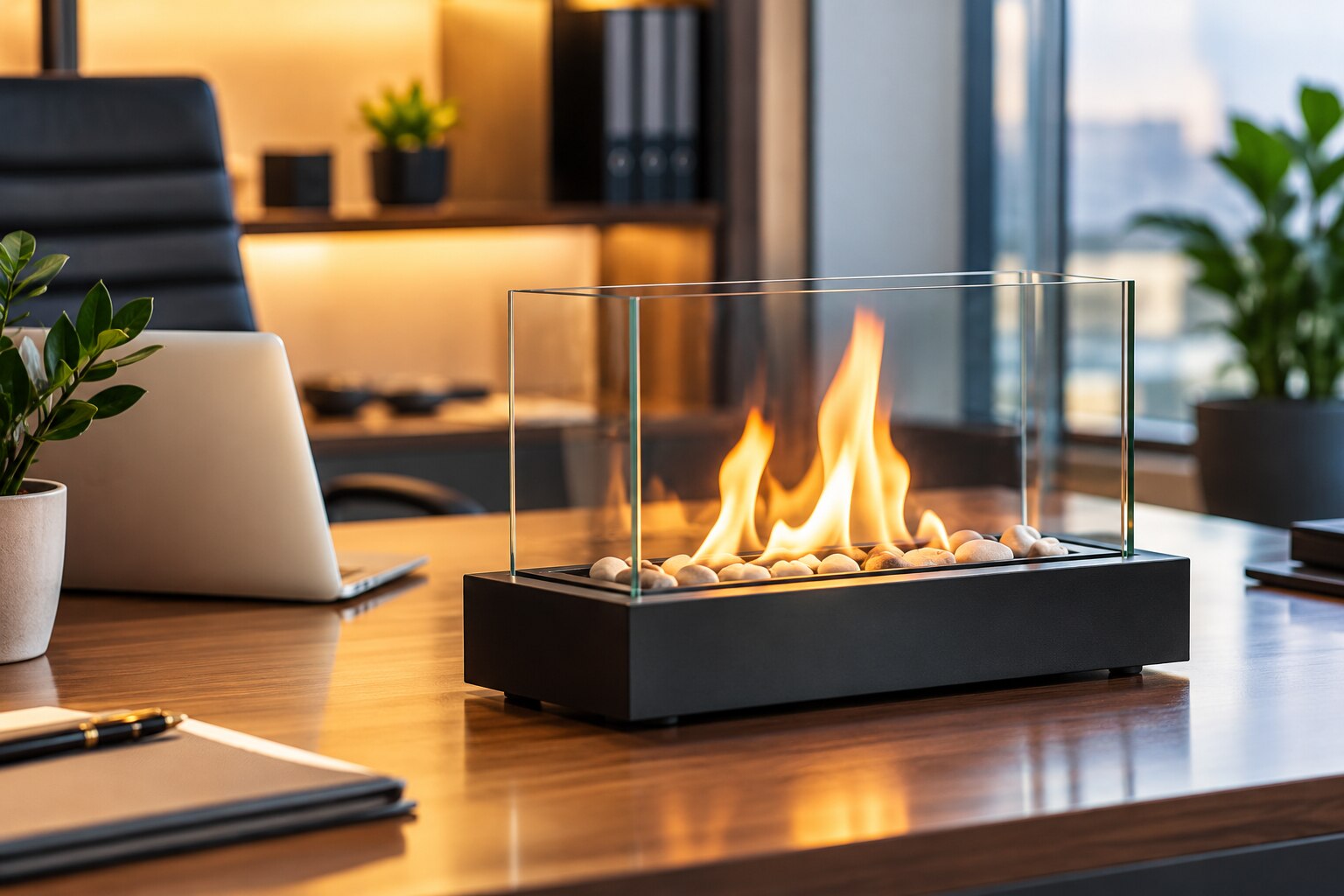
No: a 42 inch tabletop fireplace cannot safely sit on an ordinary office table unless its manufacturer explicitly approves tabletop use. “42 inch” describes a physical dimension, usually the width; it is not a safety rating, clearance measurement or proof that the burner is portable.
Check the nameplate, installation manual and product drawing for these points:
- It is identified as a tabletop model, not a built-in or insert burner.
- The table can support the complete operating weight without wobbling, flexing or tipping.
- The specified surface is non-combustible, level and heat-resistant; laminate, MDF, veneer and plastic desks do not automatically qualify.
- The required clearance zone fits around the unit, away from paper, curtains, partitions, monitors, cables, upholstery and other combustible materials.
- The flame and hot surfaces remain clear of sprinkler heads and direct air-conditioning outlets.
- The manual states the burner capacity, minimum clearances and any protective enclosure required.
- Staff cannot knock it over while reaching across the desk, moving chairs or handling files.
If the manual calls for a recessed cavity, masonry, stone or another non-combustible load-bearing base, treat the unit as built-in. Do not improvise by placing it on glass, a wooden board or a crowded reception counter.
A properly sized tabletop may still be unsuitable for an occupied office if people can bump the burner or mistake a faint daylight flame for an extinguished one.
Set the room, clearance and supervision rules before installation
An ethanol tabletop unit belongs only in a room with adequate ventilation, a stable non-combustible surface, a defined exclusion zone and continuous adult supervision. A “smokeless fireplace for workspace” still consumes oxygen and releases carbon dioxide, water vapour, heat, and combustion products when airflow is poor.
Confirm the installation in this order:
- Measure the manufacturer’s clearance around the flame and keep that zone free of paper, files, curtains, fabric partitions, upholstery, monitors, cables, decorations and packaging. If the manual gives no clearance figure, do not install the unit.
- Place it on a level, load-bearing, non-combustible surface where a chair, trolley, door or visitor cannot strike it. A 42-inch burner marked for built-in installation is not a tabletop appliance.
- Keep the burner away from air-conditioning outlets and strong draughts, which can disturb the flame or spread heat. Do not position it beneath sprinklers or where heat could affect detectors.
- Keep evacuation routes, exits, fire extinguishers and alarm call points unobstructed. Remove loose fuel containers from the occupied workspace and store them only as the manufacturer and building rules permit.
- Assign a named adult to watch the flame whenever it is lit. Exclude children, unbriefed visitors and unsupervised cleaners from the area.
If the room cannot maintain these controls, choose an electric or water-vapour office fireplace without smoke instead; it removes fuel and open-flame hazards but still needs safe electrical connection, protected cabling and its specified clearances.
Use only the specified fuel and follow the cold-refill procedure
A fuel fire can start during a refill even after the flame appears to be out. Ethanol vapour can flash back, while spilled liquid can carry flames across a desk or floor. Treat every tabletop ethanol fireplace in Delhi as hot and live until its manufacturer’s extinguishing procedure confirms otherwise.
- Use only the fuel named on the appliance label or manual. Do not substitute rubbing alcohol, methylated spirit, petrol, perfume, or a mixed fuel. Keep the fuel container closed and away from the burner while the fireplace operates.
- Extinguish the flame with the supplied snuffer or shutoff control, exactly as specified by the manufacturer. Never pour water onto an ethanol burner, move it while burning, or assume daylight means the flame has died.
- Wait until the burner and surrounding metal are completely cold before opening the fuel container. If you cannot verify that it is cold by the stated manufacturer procedure, do not refill it.
- Pour slowly into the designated reservoir without exceeding its fill mark. Wipe every spill with an appropriate absorbent material, remove that material from the area, and wait for vapour to disperse before relighting.
- Relight only after the burner is closed, dry, stable, and free of nearby paper, cables, fabric, and other combustibles. Keep a trained adult present throughout operation; never leave the flame running in an occupied office without supervision.
Delhi building approval may make an electric or water-vapour model the better choice
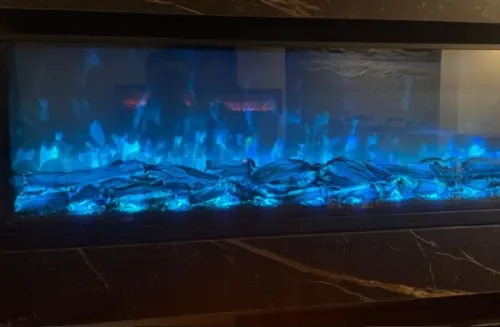
Choose electric first, water-vapour second, and ethanol only after the building’s fire-safety review accepts an open flame. For an office fireplace without smoke, electric removes combustion, fuel storage and refilling; water-vapour also avoids combustion but needs protection from condensation near monitors, files and electrical equipment.
Ask the owner or facilities manager to obtain written confirmation before ordering a tabletop ethanol fireplace in Delhi. The approval file should include:
- The building’s occupancy classification, height and floor area, checked against the applicable Delhi Fire Service requirements and National Building Code of India provisions.
- The product datasheet, installation drawing, fuel specification and fire-safety instructions.
- A marked floor plan showing the unit, combustible materials, escape routes, air-conditioning outlets, sprinklers, extinguishers and electrical sockets.
- Confirmation that the 42-inch appliance is genuinely tabletop-rated; a built-in burner needs a non-combustible, load-bearing installation and its specified clearance zone.
- Facilities approval for supervision, fuel storage, cold refilling and removal from service after a spill or impact.
If the building manager or fire consultant will not approve an exposed flame, do not treat “smokeless” as an exception. Select an electric unit with a correctly rated circuit and protected cable, or a water-vapour unit placed away from sensitive electronics and condensation-prone surfaces.
Fireplacewale’s catalogue can help you compare those technologies, but the building’s written approval—not the product label—determines the safe choice.
Related products
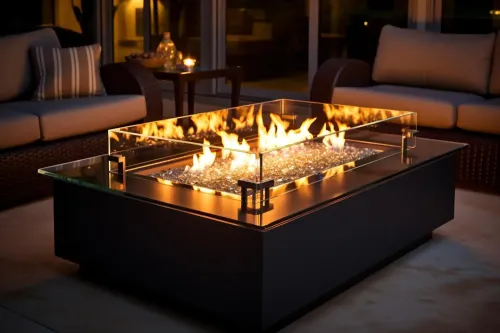
 | Ethanol Fireplace Rectangular Modern Smokeless Tabletop Fire Feature (42inch) ₹71400 Bring modern elegance and warmth to your space with this premium built-in ethanol fireplace burner. View product → |
 | Ethanol Fireplace Rectangular Ethanol Fireplace Burner – Modern Smokeless Tabletop Fire Feature (36inch) ₹61200 Bring modern elegance and warmth to your space with this premium built-in ethanol fireplace burner. View product → |
Frequently asked questions
Is a smokeless ethanol fireplace safe for an office in Delhi?
It can be used only as an open-flame appliance, with adequate ventilation, required clearances, supervision and building approval. No visible smoke does not make the burner emission-free.
Does a 42-inch fireplace automatically work as a tabletop unit?
No. A 42-inch measurement does not identify the installation type. Confirm whether the model is engineered for tabletop placement or requires a built-in enclosure.
How should you refill a tabletop ethanol fireplace?
Turn off the flame and wait until the burner is completely cold before refilling. Use only the fuel specified for that burner, and never pour fuel into a hot or burning reservoir.
When is an electric or water-vapour fireplace better for a Delhi office?
Choose an electric or water-vapour model when open-flame controls, ventilation, supervision or building approval make an ethanol installation unsuitable.
Keywords